An Innovative FPGA-Based Control Approach for Wave Generation Systems Developed by Balıkesir University Researchers
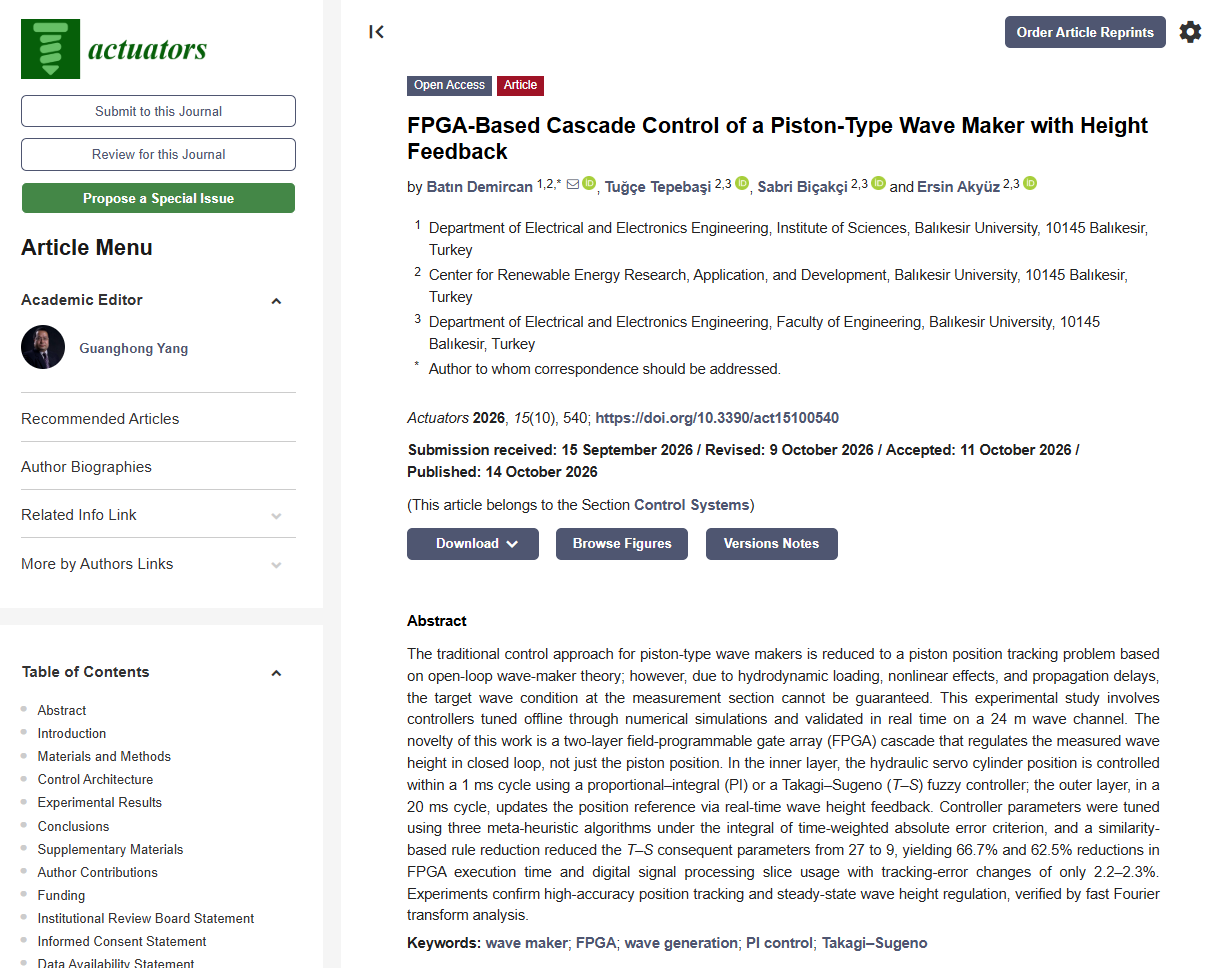
A scientific study conducted at Balıkesir University
has introduced an innovative approach to the precise
and real-time control of hydraulically actuated
wave generation systems.
The research was carried out by
Prof. Dr. Ersin Akyüz,
Prof. Dr. Sabri Bıçakçı,
Asst. Prof. Dr. Tuğçe Tepebaşı,
and Asst. Prof. Dr. Batın Demircan
,
researchers at the
Renewable Energy Research, Development
and Application Center
of Balıkesir University.
The study developed an FPGA
(Field-Programmable Gate Array) based,
two-layer cascade control architecture
to generate regular water waves under
laboratory conditions and maintain wave
heights at desired reference values.
The research focuses on achieving more
precise and reliable wave generation by
mitigating the effects of hydrodynamic loads,
nonlinear system behavior, and delays caused
by wave propagation, which are commonly
encountered in conventional wave generation
methods.
Unlike conventional approaches that control
only the position of the hydraulic piston,
the study developed an integrated control
strategy that directly utilizes the actual
wave height measured in the wave channel
as feedback.
In the inner control layer of the proposed
architecture, the position of the hydraulic
servo cylinder is regulated using
Proportional-Integral (PI) and
Takagi–Sugeno (T–S) fuzzy logic controllers
with a
1-millisecond control cycle.
In the outer control layer, the measured
wave height is evaluated with a
20-millisecond control cycle,
allowing the piston position reference
to be updated in real time.
Three different metaheuristic optimization
algorithms were employed to determine the
control parameters, with the aim of improving
the system's tracking performance.
One of the distinguishing features of
the research is the optimization of the
developed fuzzy logic-based control
algorithm in terms of FPGA hardware
resource utilization.
Within this framework, a similarity-based
rule simplification approach was employed
to reduce the number of consequent
parameters in the Takagi–Sugeno controller
from 27 to 9.
This optimization resulted in a
66.7% reduction in FPGA execution time
and a
62.5% reduction in digital signal
processing (DSP) resource utilization
.
While achieving these improvements, the
change in position tracking error remained
at only
2.2–2.3%,
demonstrating that the proposed approach
can significantly improve computational
efficiency while largely preserving
control performance.
Experimental results demonstrated that
the developed system could achieve
highly accurate piston position tracking
and stable steady-state wave height
control.
The findings were further validated
through Fast Fourier Transform (FFT)
analyses.
Based on the findings, the study
experimentally demonstrates the advantages
of combining real-time feedback with
FPGA-based control technologies in
hydraulically actuated wave generation
systems.
The developed approach has the potential
to contribute to the generation of more
precise, repeatable, and reliable wave
conditions in experimental wave channels,
particularly those used in coastal and
ocean engineering research.
Furthermore, the study provides a
methodological reference for various
mechatronic and industrial automation
applications in terms of high-speed
embedded control systems, fuzzy logic-based
controller design, and efficient utilization
of hardware resources.
Innovative FPGA-Based Control Study for
Wave Generation Systems by Balıkesir
University Researchers
Publication Information