A Pioneering Decision Support Model for Boron Research Infrastructure by BAUN Academics
16 April 2026
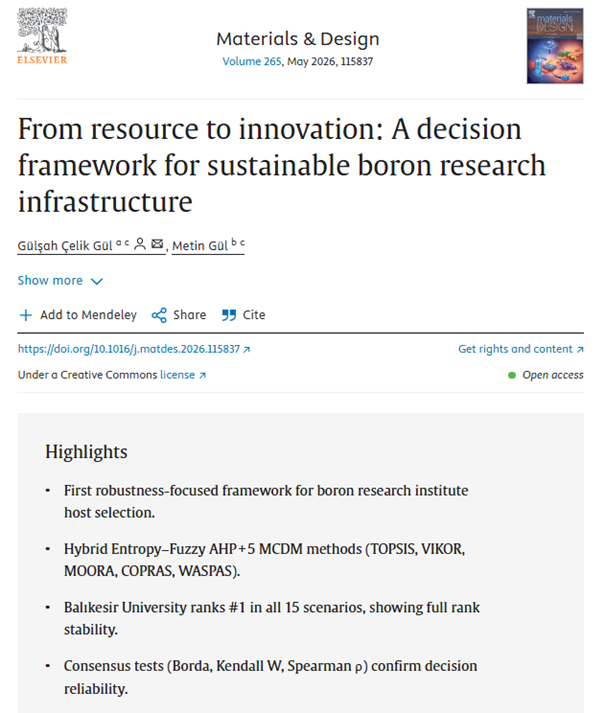
A scientific study conducted at Balıkesir University has introduced an innovative and comprehensive decision-support model for planning research infrastructure related to boron—one of Türkiye’s strategic mineral resources. The study, carried out by Gülşah Çelik Gül from Savaştepe Vocational School and Metin Gül from Balıkesir Vocational School, adopts a holistic approach by integrating academia, industry, and infrastructure components to demonstrate how a sustainable research ecosystem for boron can be established.
Titled “From Resource to Innovation: A Decision Framework for Sustainable Boron Research Infrastructure,” the study has been published in the Q1-ranked journal Materials & Design, one of the leading journals in the field of materials science and engineering, making a significant contribution to the international literature.
The research presents a comprehensive multi-criteria decision-making (MCDM)-based analysis to identify the most suitable university among four institutions located in Türkiye’s boron-rich regions for advancing boron research. The study evaluates a total of 18 sub-criteria under four main categories, including academic capacity, research infrastructure, industry collaboration opportunities, transportation and logistics accessibility, and environmental factors. Data obtained through Entropy, Fuzzy AHP, and hybrid weighting approaches were analyzed using TOPSIS, VIKOR, MOORA, COPRAS, and WASPAS methods.
A key strength of the study lies in the development of a decision framework that produces stable and reliable results with a high level of consistency across different methods and weighting scenarios. Statistical analyses confirmed strong agreement among the applied methods, demonstrating the robustness and reliability of the findings.
According to the results, Balıkesir University was identified as the most suitable alternative across all evaluation scenarios, followed by Uludağ University, Anadolu University, and Dumlupınar University. This outcome reflects Balıkesir’s multidimensional advantages, including its proximity to boron reserves, strong academic infrastructure, and high potential for industry collaboration.
The study contributes to Türkiye’s goal of transforming its boron resources into high value-added products by promoting the planning of research infrastructures through scientific, transparent, and data-driven approaches. Moreover, the proposed model is not limited to boron research; it offers a versatile framework applicable to the planning of research and innovation infrastructures in other strategic sectors, serving as an important reference for sustainable development goals.